

When we first put the key in the lock of our new house at the beginning of October, we certainly didn’t expect to be harvesting olives within a few weeks. And, in hindsight, perhaps we shouldn’t have been so fanatical. As we write this, it is not even clear what will come of our first olive harvest, but the whole process has certainly been informative so far.
Falling olives
Horta do Baldio has more than 250 olive trees. The previous owner had an agreement with a neighbour for the maintenance and picking of the trees. At our first meeting with our new neighbour, we confirmed that the agreement would continue to exist. After all, we are clueless about olive growing, picking and pressing, so any help is welcome.
The first two weeks we hadn’t even really looked closely at our olive trees, because there were so many bureaucratic things to take care of. However, during a walk in the Serra de São Mamede, we saw that people were already harvesting. Plastic bags full of olives stood at the entrance to their land. We took a closer look at our own land and discovered that our trees were already dropping olives to the ground. Is that normal?
Over-enthusiastic
We walked to our neighbour’s house on a Saturday morning to ask him if there was any picking to be done yet. He explained that this year’s harvest had come indeed much earlier than usual. That many olives were already falling off and drying out. But also that he didn’t have time for our trees yet. We agreed that we would start picking ourselves, because what a waste to have our olives drop to the ground! And so he brought us two big blue barrels and two big green nets to get started ourselves.

By hand
Olives can be harvested mechanically, but also by hand. Due to a lack of machines, but also because we thought it was nice and authentic, we started our picking the next day with a ladder and our hands. The neighbour had shown us that you can use a bare branch to hit the tree with, but very little came down with our technique. In addition, we saw a lot of shrivelled or half-rotten olives coming from the tree. And they were bad for the quality, our neighbour had told us. In addition to picking, we therefore started sorting. All the bad ones had to go and we also removed the leaves and twigs.
Kilos
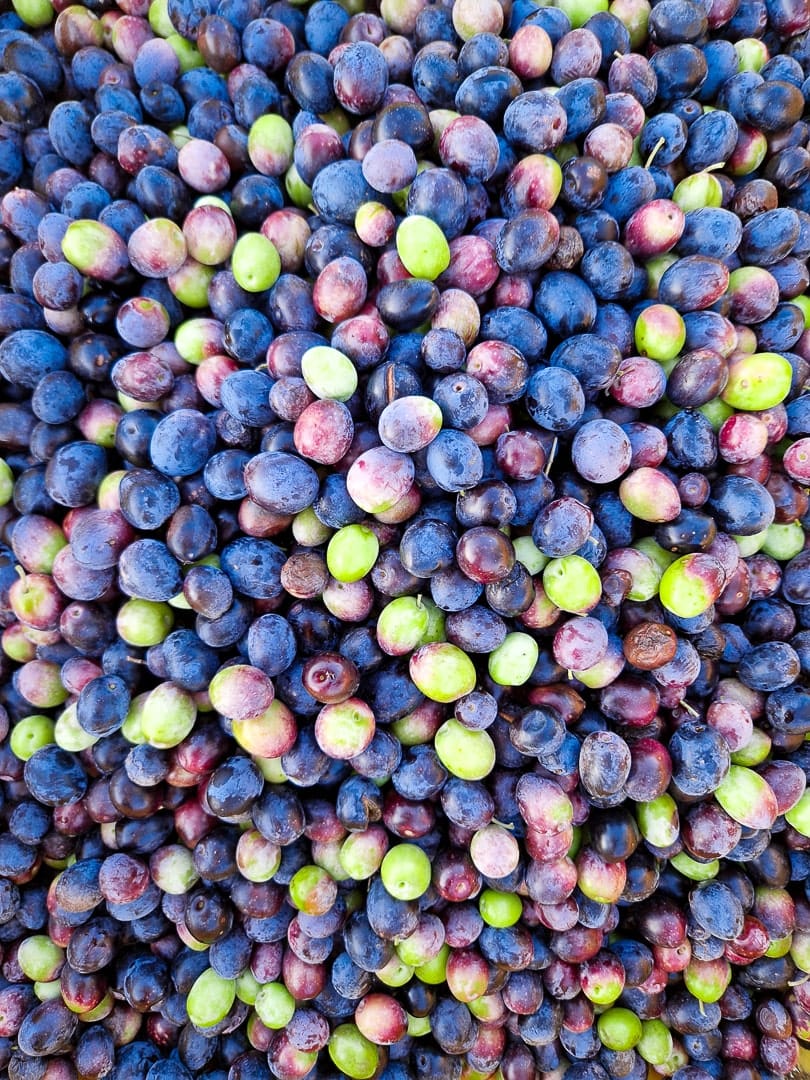
Soon we found out that we had dozens of kilos of olives after picking just a few trees! But an inspection on all of the grounds also made it clear that many trees had no olives at all. We only counted about forty that were worth picking. That still should be well enough to supply our own household with olive oil for a year. During the selection process, we choose the best of both black and green olives to cure them. We googled a recipe and filled two large jars with the most beautiful olives to be able to eat later on.
Blue fingers
A day later we were at the optician to pick up new glasses. I apologized for our blue coloured fingers. It was impossible to get them clean after sorting the olives from a tub of dirty water. We started talking about the olive picking with two employees of the shop and discovered that they knew quite a bit about it. One of them even turned out to be the son of our neighbours, who also have a lot of olive trees. A perfect time to get some more details about the process!
Which olive mill?
The two told us that at the olive press in Portalegre, you wouldn’t get the oil from your own olives. In fact, it would be a while before you could pick up olive oil from them. What???? It had never occurred to us that you wouldn’t just drive home with your own oil. If we really wanted to, we had to go to the Galegos olive mill, they said. We were happy to hear this option, because then all the sorting of the olives had not been for nothing. There was one issue, however, being that Galegos’ olive oil was generally inferior to Portalegre’s. “No problem,” I said proudly, “we’ve sorted the best olives.” The employees immediately put an end to that illusion as well. “You can’t tell from the outside if you have good olives. You won’t know until the quality has been assessed.”
Well, that made us doubt a lot. Did we want to go to Galegos so that we could actually get our own oil? Or would that be bad oil? Would it be better to go for the safer option in Portalegre? We decided that we would bring a small amount to Galegos and let our neighbour take the rest to Portalegre. That way we could taste the difference.
When I got home, I looked up the phone number for Galegos and made an appointment. That turned out to be not so easy, because the agenda was full and our already picked olives would not get any better in the meantime, the lady warned. We decided to pick a new batch of olives in the weekend before the appointment. Everything we already picked could go to Portalegre.
“How many pounds do you have?”
“Uh, I don’t know. It’s going to be a 65-litre drum.”
The lady also had no idea how much weight in olives that would be.
“I write down 300 kilos.”
Oops, we knew that 300 kilos would never go in that barrel, but okay, we would see when we get there.

Olive fly
In the evening, while resting from our hard work, we saw a post on Facebook from a foreigner in Portugal who wondered why her pickled olives were floating so high in the pot. “You can throw them away. They have been stung by the olive fly and can no longer be eaten,” was the reaction. Of course, we immediately subjected our own pots to an inspection. Literally all the black and green olives floated at the top of the pot. Our carefully selected, most beautiful olives, were ruined by the olive fly? We searched online for pictures of infected olives and compared them to our picked olives. Conclusion: clearly almost all of them were battered by the fly. We saw the very small holes everywhere. So much for our idea of a fantastic quality oil.
Change of plans
Our initial enthusiasm gave way to a bit of disappointment. In the weekend we checked with the neighbour whether these olives were still usable for something. He told us for oil they were still fine.
“And it’s okay that they’ve been here in a barrel for a few days now?”
Yes, they would be fine a while longer. He wasn’t going to harvest himself for a long time, but he could take ours to the press after we had finished harvesting. That same weekend, we picked a few last trees. The best trees we had seen so far actually. Last Monday I sent the neighbour a message that three barrels of 125 liters were full and that he could come and get them. In the evening he answered: “The olive press does not appear to be open yet.” That was it, our most recent disappointment.
The three barrels are still waiting in front of our house to be pressed. Every day the water looks worse and a dirtier smell comes out. There is a fermentation process going on in the barrels. How long do they have to stay in it? I don’t know. We’ll just wait for the neighbour to appear. In the meantime, we no longer have any illusions about excellent oil and we have also canceled Galegos, because there is simply no meaningful amount left to pick in the time we have left.

Conclusion
What did we learn from all this? That for the time being we are not good at calmly waiting to see how things go. That we are still trying to control everything and aim for perfection. Oh well, we’re only here for a few weeks, so we haven’t got a Portuguese mindset yet. Let’s just call it enthusiasm and a healthy work ethic.
So what will happen to the olives and will we ever see any oil? To be continued…


